Assignment One: Traces

A set of images showing the impact of people past and present on the environment in a small Dales village to the west of Pen-y-ghent

Taken over two days in February 2019, these images capture traces that humans have left in Horton-in-Ribblesdale. The traces, however, are more than just the result of human actions, as the surrounding landscape, has had a direct impact on the way people live, work and visit the village. The images, all taken with a wide angle lens, depict traces of human activity, but in the wider context of the landscape.

Many of the traces relate things that have been built by people (e.g. housing, the bridge, the church), whereas others relate to the working environment around the village (e.g. farming, and quarrying). Perhaps more visible reminders of people occur in the images with the gravestones and with footpath erosion, but the focus of these images is on the trace left behind rather than the people.

Horton was mentioned in the Doomsday book of 1086. The earliest building is the 12th Century Church of St Oswald. Much of the original Norman church still exists. The Tower was added in the 14th and 15th centuries. Pen-y-Gent can be seen in the background.

St Oswald’s Church with Pen-y-ghent in the background


The centre of the village is on the river Ribble, which is the only river that starts in Yorkshire that flows to the west. The New Inn Bridge was built in the late 1700s and is a Grade II listed building. Today, the bridge is too narrow for pedestrians and traffic and a separate footbridge has been built.

On the route from Settle to Carlisle, Horton-in-Ribblesdale station opened to passengers in 1877. Today, passenger trains run approximately every two hours from Leeds to Settle. The trains climb an incline of 1 in 100 from Settle to Horton-in-Ribblesdale, and spectacular views await those on the journey. The station signs (also on an incline!) are almost overshadowed by the view of Pen-y-ghent in the background.

Horton-in-Ribblesdale Station Signs

Next to the station and overlooking the village, Horton Quarry opened in the 1880s and limestone has been extracted up to the present day. The current owners, Hanson, believe that there is enough material for the next 70 years. After this, the site will be returned to grassland.
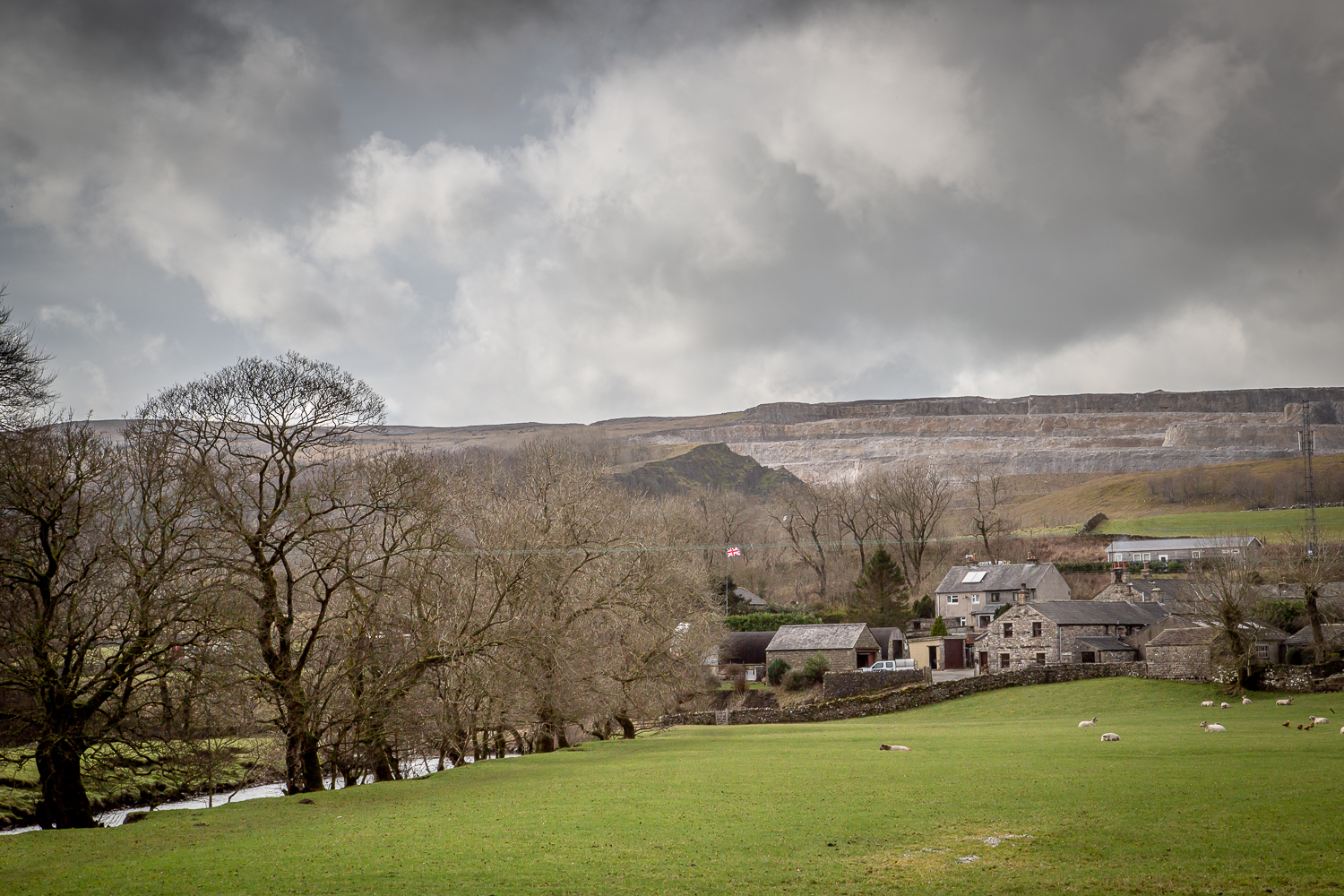
Horton-in-Ribblesdale and Horton Quarry

Both the Station and quarry affected the size of the village. Victorian terraces were built near the station, and later cottages for the Quarrymen. Viewed from the station village can be seen following the road ahead and round to the right.
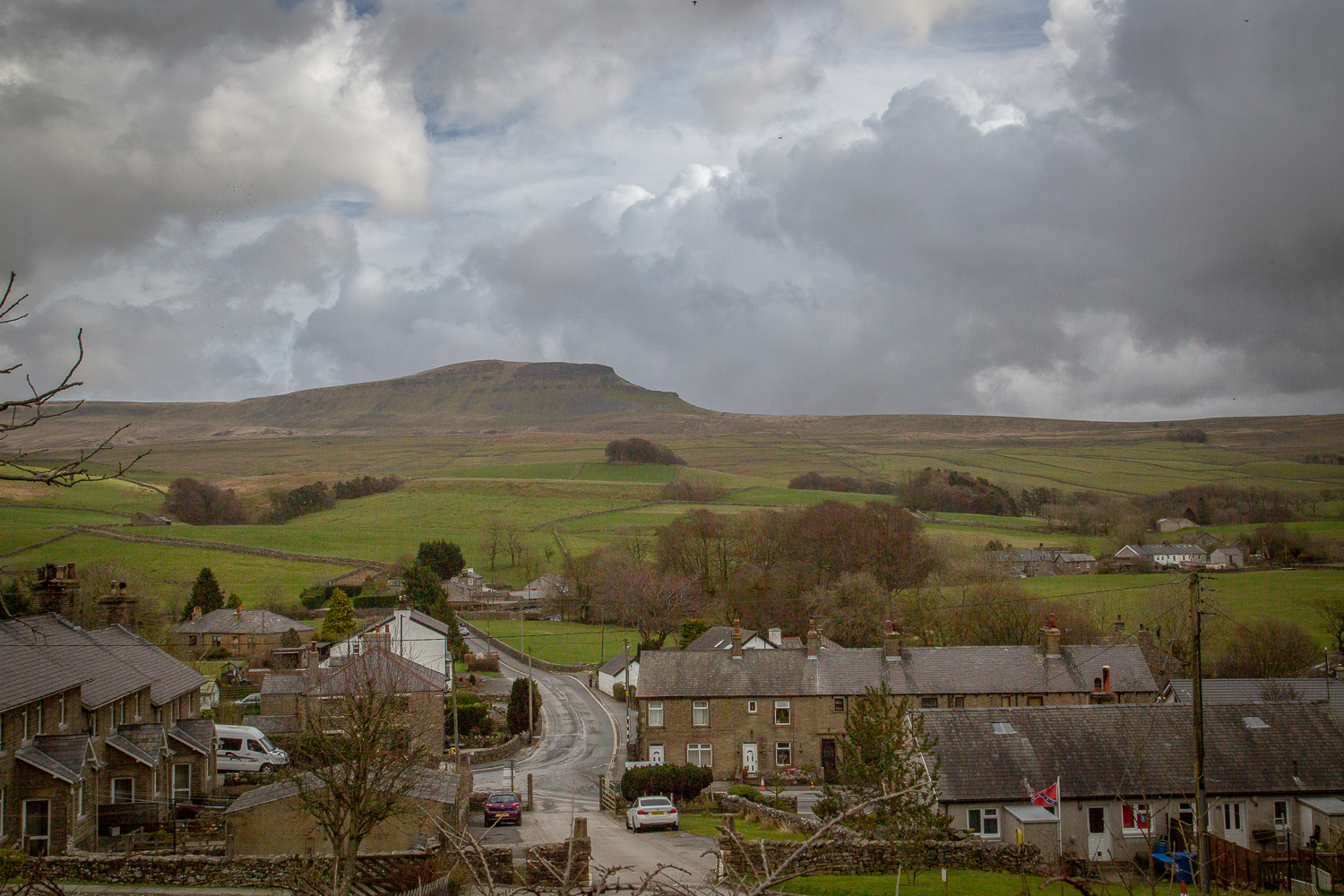
Horton-in-Ribblesdale viewed from the station

In addition to quarrying, there are many hill farms in the region. This is a vital part of the local economy and also the appearance of the countryside surrounding the village. Without hill farmers and grazing livestock, the area would be mainly scrubland or woodland.
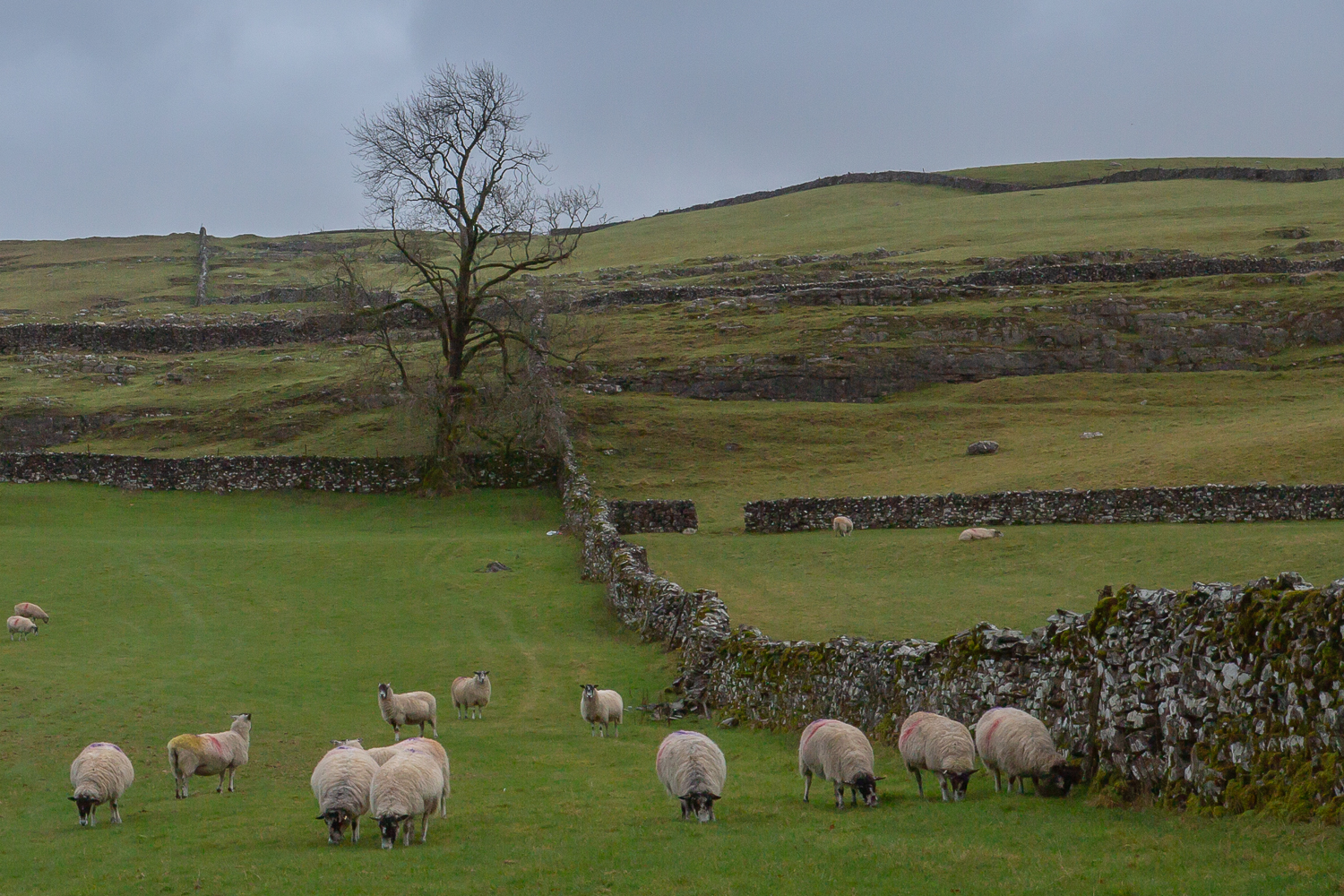
Hill Farming above Horton-in-Ribblesdale

The countryside surrounding the village has a criss-cross of dry stone walls. There are estimated to be over 5000 miles of these walls in the Yorkshire Dales with some over 600 years old.
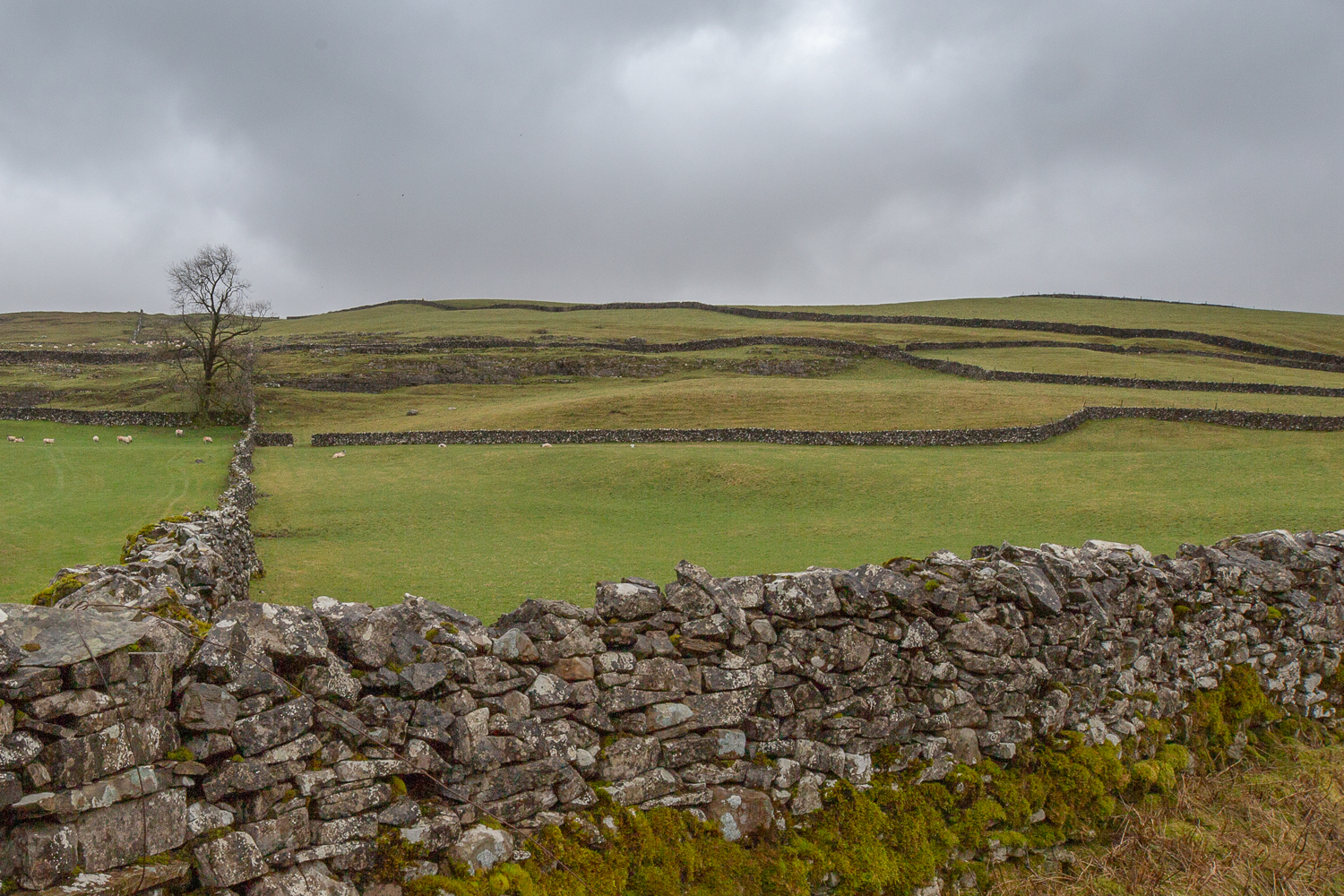
Dry Stone Walls above Horton-in-Ribblesdale


For many people, Horton-in-Ribblesdale is best known as the starting point and finishing point for The Three Peaks walk. The Pennine Way and Ribble Way also go through the village.


Public Footpath from Horton in Ribblesdale linking to one of the main routes to Pen-y-ghent

Pen-y-Ghent is a major attraction and footpaths are well worn. At busy times the village struggles to cope with the numbers of people. The National Parks Authority is looking at ways to alleviate the problems of coping with the thousands of visitors who participate in the Three Peaks Walks.

A well used footpath down from Pen-y-ghent at Brackenbottom

Many of these images have no reference to the 21st century and may evoke a sense of not being affected by the passage of time. I came away from this project with a sense of how the traces of people living, working and visiting this village are inextricably linked with the environment itself from the industrial quarry to the striking beauty of Pen-y-ghent. It will be interesting to see how people manage today’s challenges such as global warming and effect of increased tourism, both of which have the potential to have a high impact on the environment and affect the traces that people in the present leave for future generations.

Project 3 Capturing Stillness and Movement

The work of Toshio Shibata demonstrates an approach to photography that has a recognisable style with his use of lines, angles shapes and forms. Many of his images focus on moving water juxtaposed with lines, curves and shapes from man-made objects that impose control over the environment.

The aim was to create a set of images with a theme contrasting stillness and movement. After considering various ideas, mostly linked to the theme of water or the movement of animals, the plan was to take shots of butterflies, but unfortunately, Butterfly World did not live up to its name, so a change of subject was quickly planned. The final set of images feature water and fish, taken at Tropical World, Roundhay Park.

The images make use of the subject matter contrasting still green leaves with running water, but also make use of different shutter speeds and depth of field to give a sense of movement with the fish.

Aiming to capture stillness and movement, the majority of the images also create a feeling of calmness and reflection. The exception is the third image, which in contrast to the other images feels busy and is the only image not to contain any foliage, which is a unifying feature. The limited colour palate also contributes to the sense of belonging.

Taking a set of images that work in a series, is a new experience for me. I found this an interesting thought process in both reviewing the images to choose and considering what aspects of the image (e.g. content, colours, shapes) contribute towards a coherent set.

Exercise 1.9 Soft Light Landscape

As part of the research for this exercise, I looked at the work of the Italian photographer Gabriele Basilico (1944-2013) and his approach to urban landscapes. Architecture is a major focus of his work and his study, having trained as an architect in the 1970s. His preference was for black and white images shot with classic cameras, producing striking images, with a noticeable absence of people. (Hopkinson, 2013)

The absence of people in the majority of cityscapes strengthens the focus on the lines of the architecture, which to me creates a sense of decay and captures a sense of loneliness. For me, some of the most striking images are from Bord de Mer (Seaside), taken between 1984 and 1985. Particularly striking is the range of light and dark tones and the clarity of the buildings.

For the exercise, I chose the view from Otley Chevin that provides a high viewpoint over Otley and the surrounding countryside. Using a tripod, the images were shot with an aperture of f22 and developed in Photoshop to convert to black and white and adjust the levels. The second image is a composite of three bracketed images. I found that using black and white allowed me to create an image with more contrast, compared with the original colour.

References

Amanda Hopkinson. (2013). Gabriele Basilico obituary. Available: https://www.theguardian.com/artanddesign/2013/feb/25/gabriele-basilico. Last accessed 4 Feb 2019

Project 2 Shadows

Project 2 explores the use of light and shadows and is influenced by the photographer Trent Parke whose work is recommended as a starting point.

I have always been fascinated by shadows and the creative use of natural light in photography. The quote, ‘I am forever chasing light. Light turns the ordinary into the magical’ (Parke, n.d.) is demonstrated in one of Parke’s techniques which is to shoot at a time of day that provides long shadows and strong sunlight, controlling the exposure to creates dark shadows and high contrast.

His use of strong shadow, removing detail, often simplifies the scene, focussing the viewer’s attention on the main object of the image. The effect can also be surreal.

Here is an example of a recent photo taken this Autumn one late afternoon. For one minute, there was brilliant sunshine and long shadows from the trees

Inspired Parke’s use of monochrome the same image is transformed using Lightroom into a more dramatic and moody scene

Working on this project in January in the UK provided a particular challenge with finding the right light. However, a burst of late afternoon sunshine provided an opportunity to experiment in the local park.

Though these images make use of shadows, I am still aiming for something with more contrast. so this will be an ongoing project. A city centre with tall buildings casting long shadows will offer another opportunity to explore this approach.

The project has made met has made me consider different ways of using light to create a dramatic and atmospheric image. Other learning points include

  • Research is important to find the right location and time of day
  • Take lots of images
  • Be patient, wait for the right moment
  • Use the spot meter for control, either exposing for shadow or highlights depending on the desired effect
  • Black and white images can be more dramatic than colour

References

Parke, T. (n.d.) Trent Parke Profile [online]. Magnum Photos Website. Available from: https://pro.magnumphotos.com/C.aspx?VP3=CMS3&VF=MAGO31_9_VForm&ERID=24KL534BCYh[Accessed 1 January 2019]

Picture Analysis: Red Bridge, Okawa

Toshio Shibata, Red Bridge, Okawa 2007

Key words and phrases

Bridge, civil engineering, iron, journey, light and shade, perspective, railings, rectangles, red beams, road, shades of red, shadow, shape, structure, symmetry, trees, triangles

My eye was initially drawn to the red pillars of the bridge, forming triangles; followed by the roadway leading the eye through the picture from left to right. At the end of the bridge, the road appears to continue to the right, though this is partly hidden by the forest. Finally, my eye is drawn to the top left-hand corner with a ridge of trees, which leads neatly back to the top of the bridge.

A sketch showing key points of the composition
Sketch showing key points of the composition

The main subject of the photo is the bridge, however to me it raises questions. Where is the road leading? Is it a journey, from light to dark? The triangles and rectangles of the bridge are in stark contrast the to free form of the forest behind. One interpretation could be humans’ attempting to conquer the natural world.

The image has been shot in bright light to highlight the bridge, with the forest background in hazy shadow. There is also a striking shadow from the bridge, which looks unnatural. The mood is almost stark with minimal content without any major distractions

The title, Red Bridge, Osaka, effectively describes the main subject and content of the image. Including the place, instantly changes how you view the image.

The image is well composed with your eye being led from left to right, which is supported by the light moving from light to darker from left to right. There is a sense of direction with the roadway across the bridge, and the perspective of the triangular structure supports this.

Listing everything I can see in the image, reveals some assumptions and questions. Some items are without question e.g. Bridge, rivets, pillars, concrete, railings, trees, shadows, road. Questions include, is it actually a road bridge or a footbridge? Is the background steep hills, a valley, or a mountain? is the bridge made from iron? is there a power cable running alongside the road at the end of the bridge? You can not see the sky so there is an assumption from the light that this was shot in bright sunlight.

My personal response to the photo is that is is something that makes me look twice and raises questions, whilst marvelling at the feat of civil engineering. I wonder where the road is going? how high is the bridge? It feels powerful, but at the same time, there is a sense of loneliness and a question about the relationship between nature and mankind.

Here we go…

Having thought about it for some time, I finally signed up for the Foundations in Photography course. I had been looking at the photography degree, but decided that this was a better fit for my needs and skill set. I should say at this point that I am addicted to studying and work in education promoting the benefits of lifelong learning.

I didn’t get off to the best start setting up the blog. A warning for any Mac users, don’t use Safari. Once I had figured out the problem and switched browsers it was relatively straightforward though until then there was much head scratching and cursing.

Just starting the course has made me more aware of the images that I take even if they are not for the course. At the end of the first project of 100 photos, what have I learned?

  • Read the instructions!
  • I like to take my time, 100 photos in 30 mins was a challenge for someone who has perfectionist tendencies
  • How to adjust midtones in Photoshop
  • To be more critical about what I like/don’t like in my images
  • To have a systematic workflow for storing and editing images
  • How to create a contact sheet
  • How to rename photos in Lightroom
  • If you want to take a number of useable photos in a short space of time then planning is vital
  • Some of the things I like in photos are textures, patterns, contrasts of colour and shape, curves, reflections, shadows
  • Take photos from different viewpoints
  • Take close-ups and photos that show the context of the subject
  • Check the depth of field
  • Avoid distractions and look for suitable backgrounds.

What skills would I like to develop?

  • Taking photos of people
  • Creative use of light
  • Knowledge of the work of other photographers
  • Photoshop skills – I can do the basics, but would like to know more
  • Telling a story or expressing a concept through images
  • Composition

Finally, I have enjoyed looking at the work of other photographers on the course in their blogs. I’m looking forward to being part of this community of photographers.

Project 1 100 Photos

A Walk on the Walls

A Walk on the Walls is my response to the Task to take 100 Photos in 30 mins, using a variety of subjects, close and wide shots, different viewpoints and framings. The project relates to a walk on a small section of the city walls in York.

Foolishly, I thought this would be quite easy. In practice it was a challenge to take 100 photos, especially shooting in manual mode without too much time to think about the camera settings. I usually use aperture priority mode so this was a step outside of my comfort zone. I also like to take time to look before taking any shots making this was a new experience and I struggled to get 100 photos.

The final selection of photos reflect things I find interesting in images, e.g. textures, shadows, shapes, contrasts of light. Though a challenge, the project has made me think about my approach to getting a range of interesting shots in a short length of time and the importance of having a systematic process for editing and storage.